I’m feeling sluggish, untethered, in that “I know I need to do things but don’t feel like it” kind of way…
I want distraction, diversion.Some sort of conversion.
Conversation. Creation. A new situation.
I need a reprieve from the schedule. Yet I need a schedule.
I need motivation, but am in stagnation.
I need rest, but when lying down don’t receive it.
I find fatigue when sitting up, trying to pay attention, striving to do the things I should be doing.
Lying down I find the mind. Racing. Mulling. Wandering, wondering, investigating, contemplating.
The things I’m interested in don’t seem made for the day. I want to let my mind explore, seek out the interesting, dive deep. That’s a nighttime habit.
Yet the daily to-do’s need to get done.
How to get unstuck from the muck of those mundane tasks? The ones that stare at me from my perch at the kitchen island?
Change the under-the-sink water filter that expired months ago. The fresh one is sitting right there, staring at me like a sentry.
The bills too. Stacked neatly nearby, ready to be paid.
C’mon, what are you waiting for?
Waiting for a friend to say come play?
Really, waiting for another to say Come Work.
An antidote to the sentiments above: Van Morrison’s “Days Like This”
There are those times in your life when your energy sags, your mind feels mushy, and your general view about life is … meh. Usually for me, that means it’s February. In our younger days my friends and I used to call it “The Febs.” Even the word itself is low-energy. It’s not vibrant like “March,” also a verb, and one easily finished off with an exclamation point. It’s not chirpy and cute like “April.” Not musical-sounding like “June,” which brings to mind a major chord. Or bright and sunny like “May,” conjuring images of spring flowers. Not to mention, all are female names.
February isn’t assertive like January is. January seems to announce itself — maybe it’s the hard “J” sound. It also has a phonetic attractiveness. Pronouncing it invites you to really enunciate, but in a fun way, like you’re exercising your mouth: “JAN-YOU-AIRY.”
Unlike February, which starts with an “F” — hardly the superior letter. In fact, it rates an “F,” if you’re grading the letter grades. F is flabby … “phhh” … It just peters out. February also contains the awkward “br” sound — does anyone really say Feb-RU-ary? No! Everyone glides over it hurriedly — FeBUary. Alright, maybe there is the occasional “R” in there, but really, no one cares. In fact, February tries to quickly get itself over with by being the shortest month. It’s like it’s saying, OK, OK, we know… we’re trying to get out of here and get on to March, which at least has spring break and brings the possibility of early warm weather with it.
March is anticipatory — spring is coming! Indeed, the first day of spring is in March. February is simply the last slog of winter. When will it end? Seriously, it’s STILL February?? Thank god it’s the shortest month!
February also contains one of the most dubious holidays, Valentine’s Day. Is there anyone who actually likes Valentine’s Day? Besides snotty-nosed grade-schoolers who probably spread those winter colds with the store-bought Valentines cards they add a sticker and their name to and distribute to every child in the class because God forbid anyone gets left out?
So the day that is supposed to symbolize romantic love — a love that has you declaring to your one and only, “I heart-emoji you forever, here’s a card and chocolate, and let’s go out to a special dinner alongside dozens of other couples on the exact same night to celebrate our love” — is actually for kindergarteners, restaurants and CVS.
I suppose February does have a couple of redeeming qualities in President’s Day and Black History Month. The former brings a day off from school, which is nice, and it celebrates the birth ofWashington and Lincoln, which is also nice. And the latter invites us to focus on important stories and figures in black history, some well-known, some not. In fact, these two came together for our family this year in a spontaneous way. While a number of friends took advantage of the holiday to go away for the weekend, I decided that even though we would be in town, we could at least take a little field trip. I’d been wanting to see the National Gallery’s exhibit featuring the work of African American photographer Gordon Parks, and it was closing that weekend. Nothing like a deadline to create action.
So I announced to my husband and three teenagers (via a group text, naturally) that we would all be blocking out a few hours on Sunday afternoon to visit the National Gallery and go to dinner afterwards. No arguments, no laments. No choice.
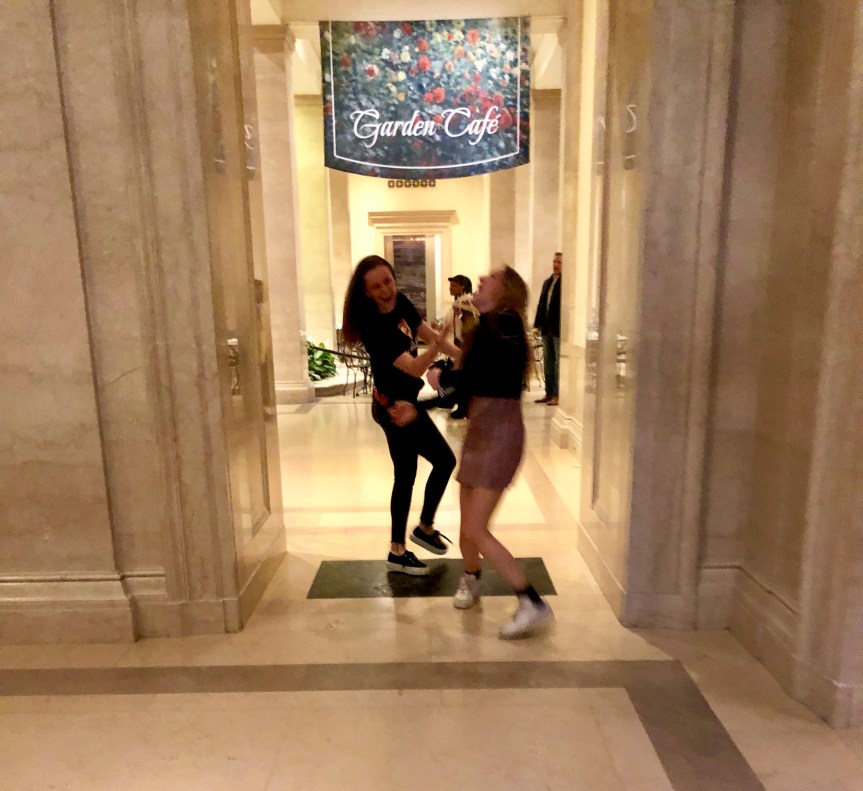
And, even though it felt like dragging elephants, we arrived at the gallery before it closed. I was in a sweat by the time we had weaved our way through the labyrinth of rooms to reach the beginning of the exhibit. I rounded the corner at one point to find the kids, including their friend who came along, gathered in the middle of the room, ignoring the photos and chattering away. I shushed loudly and waved my hand to scatter them. Turning, I continued to methodically make my way through the exhibit, carefully reading every word accompanying every photo. Eventually, my phone flashed with a text from one of my daughters: “Can we leave soon? We’re all pretty hungry.” Just in case I was thinking of lingering, my husband chimed in, “Me too.”
I sighed and started walking back toward the entrance. Hopefully they had absorbed something. We headed to dinner at a nearby pizza restaurant, and as I settled into the booth, the kids engrossed in each other and Instagram, I looked at my husband. Do you think they enjoyed it?
“It was a home run,” he answered.
And there you have it. Maybe they didn’t read every word, or even glance at every photo, but I’d brought them all to the table, dammit. At dinner we had some fun, funny and insightful conversations. Turns out after scooting through the photo exhibit, the kids had gone upstairs to view the American landscapes. Not my idea, but maybe better that it was theirs. And I consider that little nugget a victory — especially against the one-two punch of teens and their ubiquitous screens.
Forced Family time in February. The three F’s. Turns out three F’s are much better than one.
It is winter in Washington — real winter. Not just mid-50s, open-jacket winter, but hat-and-gloves, zipped-parka winter. Temps-in-the-teens, see-your-breath winter. Our old house, with its myriad windows and doors, is leaking heat, and the arctic air is seeping in through cracks and crevices. I’m closing curtains in our chilly dining room, with its three doors to the outside and four windows.
I keep my coat on when I walk in the house. I beeline for the teapot. I stay inside, cooking, for once. Chicken tetrazzini, sweet potato and kale soup, homemade tomato sauce — all in one week. That’s pretty good for me.
I spent almost an entire day last week inside reading a page-turner. It felt as decadent as a spa day.
I bought a soft, luxurious throw at HomeGoods recently. Not a minute after walking through my door, I was on the couch and under the blanket, drifting off to the dulcet tones of Wolf Blitzer reporting the latest, worst news.
A self-declared warm-weather girl, I was surprised to feel disappointment at a temporary reprieve from the cold snap. One day last week the high reached the mid-60s, and people were out jogging and walking their dogs. I had just settled into the snuggle mode of the season and wasn’t ready for the spring-like shift. The change threw me, forced me from my cocoon too early.
I anxiously checked the weather and was relieved to see the mild temps plummeting in a few days. I wouldn’t have to emerge for long — I could retreat back into my puffy coat with the furry hood, wear my socks to bed, sip my chai tea latte.
The new year may be a time for rejuvenation, but for me, this one has felt like a time for contemplation. Instead of resolutions I am thinking about intentions, and focusing on one word instead of a list of “to-do’s.”
That word is return. Return to myself, my goals, and in general, the present. Life presents distraction — my own goals are buried under the daily tasks of home and family-keeping. The projects that I want to pursue are in sight yet not graspable, as if sitting at the bottom of a pool. They don’t float to the top the way carpool pickups and appointment making and grocery shopping do. They lie in wait for the water to drain.
But maybe the winter is what’s needed to reach those depths. The cold brings more silence, less doing. More staying, less going. That’s not my usual world. Right now, I am accepting instead of fighting the freeze and all that it brings. Except, of course, when the season suddenly turns on its head. But that upending also makes me realize how much I need this time to pause, and dive inward.
Today’s post is something a little different. I’m participating in a “blog hop,” an effort by some of us bloggers to introduce readers and each other to other interesting blogs. It includes answering four questions to give an idea of why we write and how our blogging process works.
One of my fellow blog hoppers is Denise Powers, an American in Paris who, when she moved there, created her blog “I Would Read That.” Denise and I were in a writing group a few years ago, and I’ve loved keeping up with her through her very funny, sharply written posts about life in France with her French poodle, Ferdinand. Here are a few bon mots:
“Apparently standard poodles are virtually unknown in France, except by reputation, much as one might know of a hippo or a giraffe, but never expect to meet one on the street.”
One of the things I love about Denise’s blog is living vicariously through her. Many of us dream of one day picking up and moving to another country, and she actually did it.
Also check out “Literary Mileage,” a blog from another wonderful writer, Judy Leaver. She splits her time between Washington, DC, and South Florida, balancing supporting herself through writing while living a fun and art-filled life. For instance, currently Judy is living in Mexico for a month, studying Spanish.
OK, so here are my brief answers to the four questions:
1. What am I working on (think about that metaphorically)?
The short answer is that I’m usually working on a) being a better person — because it’s often so hard; and b) finding the humor in being human.
2. How does my work differ from others of its genre?
I’m not sure it really does. I write about what I’m thinking about, what I’m observing. So it differs from other first-person writing in that it’s coming from me. It’s my voice, for better or worse.
3. Why do I write what I do?
I write for sanity, for clarity, for my own enjoyment and hopefully for others’ too. In writing something specific, hopefully I can touch upon something universal. Writing can be frustrating and confounding and the hardest pursuit imagineable when you’re trying to figure out what you want to say. But when you’ve written what is true and in the way you want to, it’s extremely satisfying.
4. How does your writing process work?
I’m a deadline-oriented person (I used to work in newspapers, the perfect job for procrastinators), so this blog is supposed to act as my external deadline, my place to publish. I have set up a system to try to meet my (internal) blogging goal of once every two weeks by having to “turn in” a piece to “an editor.”
This seems to be working pretty well for me, with the exception of these past two months. I look forward to summer and hopefully more writing since I was inspired to begin this blog last summer.
Bonus question: Is there a better word than “summer”?
I received one of my best Christmas presents ever this past year. I don’t think it was very expensive and it certainly isn’t beautiful to look at, as objects go. It is made of plastic, in fact, a simple organization tool. And in that lies its beauty.
I’m a tea drinker, especially in winter. It’s interesting how my habits are seasonal — I rarely make a cup of tea at night at the beach in summer, for instance. However, in the winter and fall months, I have steaming chamomile or ginger or sometimes a soothing sleep-inducing elixir almost every night. I don’t always drink much of the tea once made — I find the almost-full cup on the family room coffee table the next morning — but the act of making the tea persists and soothes.
Except the beginning of this ritual has always created in me a bit of angst. After putting on the kettle, I open the cabinet and reach up to the second shelf above the cereal (there’s always at least three opened boxes of Honey Bunches of Oats), where all the tea cartons are crammed into two metal bins, some spilling out over the top, others wedged in so I can barely reach them. My caffeine-free nighttime favorites are usually the ones lying on the top, so not hard to access. But each time I pull out the metal container, some boxes fall to the side or on the counter or, occasionally, on my head.
Oh, I’ve tried to organize them — divide them into two groups, herbal and caffeinated, or pack according to size, like jammed-in puzzle pieces. But like that pair of jeans that is just too tight, they never manage to really fit. So when my sister sat in my kitchen and asked me what I wanted for Christmas, I thought, what do I really want?
“I want a tea organizer. I have no idea if they make those. And I don’t want a fancy box like they present to you in restaurants. I want something that can go in this cabinet.” As if working on the “The Price is Right,” I reached up and pulled out my makeshift system of ill-fitting boxes in too-small bins, gave her a “see what I mean?” look, and she nodded.
“OK, I’ve got it. I’m not saying I can find it, but I’ll try.”
And that was that. I basically forgot about it. I didn’t start looking for the item myself — no googling “tea storage” or asking if she’d found it yet. That would make me seem organized. In fact, I only realize I have the “tea problem” whenever I make tea. Then I make the tea and the problem goes away, and I don’t think about it any more — until the next night, when I make tea again.
So when on Christmas Day I opened what is officially named the “Tea Stand” (I only just now noticed its name etched on the end), I was a little surprised. I surveyed the slim, gray box with two-by-three rows of clear slots on each side and an indented groove at one end to easily grasp the whole miraculous contraption, and a smile spread across my face.
“I can’t believe you found this.” I said, beaming. “It’s perfect.”
Which it really is. A beautiful, plastic house for tea. Or maybe more like a tiny apartment building — one that may as well have been designed by Frank Lloyd Wright I far as I’m concerned. Weeks after receiving it, I felt compelled to gush to my sister: “I’m so happy every time I make tea.”
Such a small item, such a huge difference. Suddenly, instead of reaching up and wincing when little boxes bounce off my head, I gratefully grasp the grooved plastic handle and pluck a tidy packet from one of the open-topped slots on either side.
Without a modicum of angst, I unwrap the bag, place it in the mug, and put on the kettle. Then I slip the synthetic sculpture back onto the shelf, as if returning a book to its exact spot at the library. A perfect fit, this perfect gift.
What is it about getting “the perfect gift,” I wonder. Of course, it’s pleasing to use or look at or do, depending on what the gift is. But there’s more. It’s affirming. The perfect gift says the giver knows you, and you feel known. In giving to you, they “get” you. That’s a gift that, like a good cup of tea, warms to the core.
Pharrell Williams gets “Happy” – which is how I feel now every time I make tea:
Resolution. The word of the new year, the word of now. We are resolving to start anew, set a goal — lose those pounds, finish that project, clear out the clutter. There are so many resolutions.
But what of this word “resolution”? What does it mean? One definition is “a firm decision to do or not to do something.” It’s a word of doing, not one of thinking, or musing, or considering. As Diana Nyad, the 64-year-old who finally succeeded on her fifth try to swim from Cuba to Florida, said in her recent TED talk (quoting Socrates): “To be is to do.”
“Resolution” also brings to my mind, at least, the idea of re-solution. Re-solving. The idea of “again.” Maybe we start an entirely new project, but more than likely we find ourselves staring discontentedly at a familiar picture. Often our impulse is to throw it out and start over completely, but more than likely all we really need to do is add a smidge of color here, take away a shadow there, paint over a few drips. A tweaking.
I know I do this in my own life — I often think I need to wipe the slate clean, approach life with a “whole new attitude,” go for the sea change. I think, I should cook family meals every single night! I should write for an hour every single day! I should take up piano lessons again! Naturally, that’s a setup for failure. Not to mention it just makes me want to go watch “Modern Family.” Besides, what if we actually did achieve these things? Would that really bring us ultimate happiness — or whatever it is we think we’re looking for?
What I’m starting to realize, unexciting as it may be, is that I just need to do things a little differently. Shift slightly. Decide to turn on the oven a couple of times a week. Sit down at the piano instead of walking past it. Bother to craft a good email. Baby steps.
Our resolutions relate to issues we face again and again. And there’s nothing wrong with resolving to “solve” them again and again. That’s really what life is about. Usually, we don’t have a bunch of new problems. We have old ones that are still there. And most of the time, there’s no solution. Instead, it’s a daily struggle. That’s why in disciplines like yoga, or music, or writing — in just about everything — the word “practice” is used. We practice at life. And we do it every day, every hour, every minute. Practice doesn’t make perfect, but it does make better.
As the author Eckert Tolle suggests, “Die to the past every moment.” No matter what has happened in the past, all we truly have is the present. All we have is Now. Every moment presents a chance to “do” and “do” again. All year long, all life long
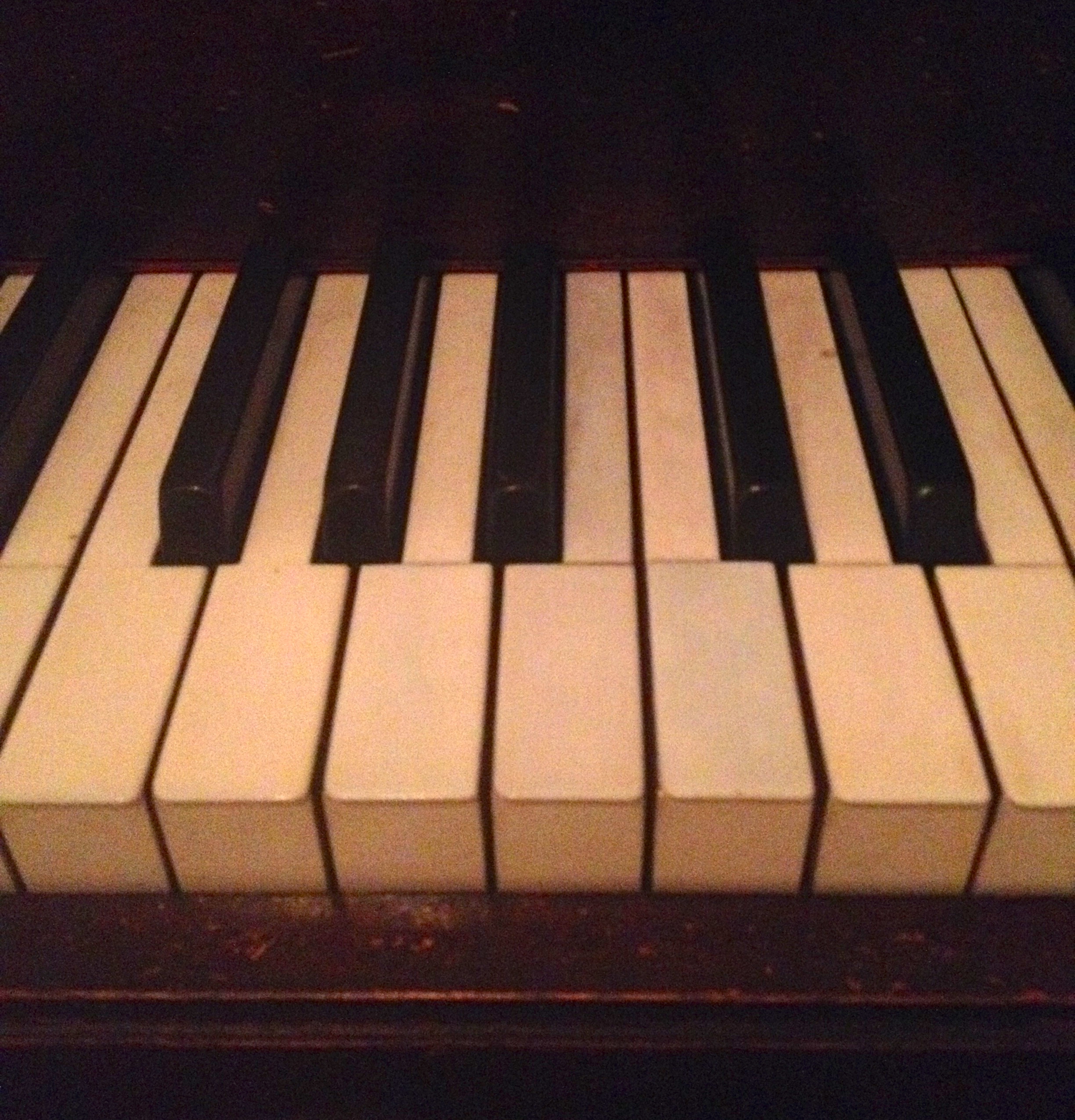
The keys await… (Maybe if they were cleaner I’d be more likely to play them!)
In the previous post I described spending many hours making a photo album for my father’s 87th birthday. We presented it to him last weekend during a big family celebration. All in all, it was a huge success. But there was one small glitch that ultimately presented itself as an opportunity for me (once again) to “deal” with imperfection — and my own temper. Not that I expect perfection and niceness all the time, but considering all the effort I’d put into the album, this instance was, in retrospect, pretty, um … funny. (Apologies in advance to my husband, who is an amazing person and not only managed to spend the entire weekend with my family, but actually seemed to enjoy it.)
Here’s the scene: It is lunchtime Friday and my parents have just arrived at the hotel. Since our kids are swimming in the pool and not ready to eat yet, my husband decides to have lunch with my parents in the cafe. Toward the end of this meal, my daughter and I, dry and dressed by now, decide to join them. As I settle into the extra seat at the table, there are smiles and hugs and happiness all around. Then someone — maybe my mother — says something about how my husband has just let my father read what I wrote about him that week — including the part at the beginning where I say we are surprising him with a photo album for his birthday.
As my parents express appreciation for what is essentially a tribute to my father’s values and even temperament, especially as a parent, I can barely keep a lid on my own temper. I just look straight across the table at my husband, as my parents on either side glow and say nice things, none of which I hear because of the steam shooting out of my ears.
I give the “laser look” to my husband, trying not to be too obvious to my dad, seated at my right, so it probably looks like I have a weird tick of smiling to my right, then turning to glare straight ahead at my husband, then smiling right, glaring ahead, smiling, glaring …
My husband throws me a quizzical look like, What is wrong with you?? As my parents chit-chat, I mouth to him, “It was a SURPRISE”… I do that, demonstrably, a couple of more times, as I see it dawning on him what has happened.
“Sorry,” he mouths back.
I am fuming. How could anyone be so mindless? He let my dad read it?? ARGHHHHH!!!
But there is literally nothing I can do except sit there, simmering, try to slap a smile on my face and change the subject. And, of course, talk only to my parents for about 10 minutes and not so much as glance at my husband.
Finally, I shoot him a look, and he looks right back. I can tell I am going to have to suck this one up. His mistake comes from a good place, after all, and my father is behaving as though nothing has happened and he has not just been informed that the family gathering this weekend is essentially for him and that furthermore, there is a surprise gift we all conspired to keep secret from him for weeks.
I keep up light conversation, but inside am still incredulous. I mean, what??? I am going to need some time to calm down. I know this is my husband being sweet, supportive, loving — it’s all good!! Right?? Except I am pissed.
We rise from the table and my mother, also in on the secret, murmurs to me, “Don’t worry, I don’t even think he got it.”
Yeah, right.
My husband and I speak briefly and I say something not very conciliatory like, “I can’t believe you did that,” and then we all walk out of the restaurant. Yeah, I am really proud of my generous and understanding behavior. I know I need to just shake it off and move on.
It takes about a day — in the workout room on the elliptical machine I realize that I’m still ruminating over The Big Slip — but I eventually calm down and am even able to tell myself that maybe it’s a good thing my dad knows about the album. He doesn’t love the limelight, and perhaps this has given him a little time to prepare.
When we finally present him with the album two nights later, he appears to express genuine surprise. And delight.
And my husband and I don’t talk about it again. Oh, there is one moment on the car ride home, when he turns to me out of the blue and says, “By the way, your dad didn’t know anything about the album. It was a complete surprise.”
I say nothing for a few seconds. Tiny vapors waft from my ears. I look back at him.
I’m basically a lazy person. I really don’t like to exert myself unless there’s a good reason. I’m also basically an optimist. I think life tends to err on the plus side, and things usually turn out how they’re supposed to. These two traits can sometimes lead me down a tricky path, one strewn with over-confidence and under-appreciation of reality. I’ll give you a recent example.
I’m a fair-weather runner, meaning that in the wintertime, unless I’m feeling particularly disgusted with myself, I will find all kinds of reasons not to run (like, it’s 35 degrees outside, or, I’d rather nap). This also means that when spring comes around, I don the running shoes and hit the pavement as though I’ve been running all winter. I have learned over recent years that I need to stretch and strengthen in order to begin again, but for the most part, I just start running.
Two years ago a friend–I’ll call her Olivia–convinced me to run a half marathon just after Labor Day. For a “seasonal” runner (sounds much better), I surprised myself and took this fairly seriously. I trained a bit over the summer and built up my mileage to where I finally ran 10 miles. If you can do 10, I’d heard, you can run a half on race day. Still, I was nervous.
The morning of the race, Olivia showed up at my door red-nosed and stuffed-up, tissues in hand, but still determined to run. (Her work ethic is much stronger than mine.) Suddenly feeling a little lighter, I valiantly told her we’d go as slow as she needed. During the race, I, martyr-like, velcroed myself to her side (“I wouldn’t dream of leaving you!”). At our thankfully civilized pace, I crossed the finish line feeling pretty good about my “accomplishment” alongside my sniffling friend, who’d run 13.1 miles suffering from what her doctor later diagnosed as a full-bore sinus infection.
After skipping last year, we decided to run it again this year. With a big birthday looming, I thought, why not? Half marathon for a half century? Sounds good to me!
Except, I was having a bit of trouble getting motivated this summer. Down at the beach, I’d go running and have to give up after several miles or take breaks because of the heat. I rose early a few mornings, but was also coveting the extra winks and the fact that my children are finally old enough not to burst into my room asking for breakfast or an early schlepp to the ocean. (Guess I love sleep more than running.) I figured I was taking the stairs daily at this three-story beach house. Besides, I’d run this race before, right? It wasn’t so bad … Right??
But by the end of the summer, it hit me: the most I’d managed to run was 8 miles. Once.
Then, a couple of days before the race, Olivia emails me: “I think we should leave at 5:30 a.m. to get to the race in time.”
“I have clock shock,” I email back. I can’t remember the last time I was up at 5:30 a.m. And stayed up.
This isn’t like last time, I start to realize. I am truly nervous. This isn’t just a lark. I could get seriously injured.
But this is also a matter of pride, I tell myself. I am going to run this thing, even if I have to walk it. Although I’d rather not walk.
Well, as it turns out, the week before the race Olivia’s back is acting up (not from running, ironically), and whether she will even participate is a question. While I don’t want her to run and get injured, I am secretly relieved that if she does run, we will not be trying to break any records. Once again, I could be called on to “sacrifice” pace, refusing to leave her in the dust as some other lesser and more competitive friend might do. No, I will be the trusty sidekick, ready to catch her if she collapses–but hopefully not right on top of me.
Considering her track record (ha), I’m not surprised when Olivia decides last-minute to run. The day of the race, she appears at my doorstep having popped three Advil and armed with her phone in case she needs to call for backup. I cross fingers for her and breathe easier for me. This may just work out, and no one will be the wiser that I’m practically winging it.
The starting gun goes off and we are keeping a nice pace, chatting and dodging runners here and there. But as the race progresses, I see that Olivia has not clued into my secret plan. She is barely slowing down at the water stations, and her eyes are focused and determined. Mid-race, as another friend and I stop for some quick stretching, Olivia keeps scooting along with barely a glance backward, calling to us that it’s hard for her to stop and start again. I realize with growing alarm that the only way she’s going to run this race is by not stopping at all. We are the ones being left in the dust.
My friend and I turn to each other, eyes wide, acknowledging that the runner with the ailing back and back-up phone is ahead of us. Somehow, we summon some energy and kick into gear, trying to catch up with the female Forrest Gump.
In the final stretch we do just that, and cross the finish line within a few seconds of each other. As we slap backs and guzzle water, I marvel that it is not even 9:30 a.m. I begin plotting my nap time.
“The obstacle is the path,” as the Zen proverb says. It’s the idea that what we dread or fear is actually what we need to face in order to grow. But starting down that path, and staying on it, isn’t easy, and sometimes we need a few signposts along the way. I’m not saying running a half marathon is the ultimate answer–it’s just a foot race, after all–but it was a challenge I certainly was dreading, and I’m thankful for the friend at my side and the other one up ahead, pulling me further than I thought I could go.
But boy, are my calves sore.
Sometimes you need a little push to get down the path.




 Through the trees